Power System Studies help engineers evaluate electrical system performance and assess the impact of faults and abnormal operating conditions. In addition, these studies improve overall system reliability and efficiency.
At SEN EDS, the Power System Group uses advanced software such as ETAP and DIgSILENT. As a result, engineers conduct accurate analyses and perform simulations in line with IEEE standards.
Our Power System Study Services Include:
STEADY-STATE STUDIES
Load Flow Study
Engineers evaluate voltage levels, power distribution, system losses, and equipment loading under various operating conditions. This approach supports stable and efficient system performance.
Short Circuit Study
Fault current calculations verify equipment ratings and confirm safe operation during fault conditions. Therefore, the system withstands potential short circuit scenarios.
Harmonic Analysis
The study examines harmonic voltage and current distortion levels and identifies practical filter solutions. Furthermore, proper harmonic control prevents nuisance tripping and overheating.
DYNAMIC AND TRANSIENT STUDIES
Transient Stability Study
System behaviour during major disturbances, such as faults or sudden load changes, requires careful analysis. Consequently, the plant maintains synchronism during critical events.
Motor Acceleration Study
Motor starting performance and system capability during transients demand detailed evaluation. In particular, this process prevents voltage dips and excessive stress on equipment.
Grid Islanding Study
Controlled island strategies maintain supply to critical loads during grid disturbances. As a result, essential operations continue without interruption.
PROTECTION AND SAFETY STUDIES
Relay Coordination Study
Optimised relay settings ensure selective and reliable fault isolation. Moreover, proper coordination reduces unnecessary outages.
Arc Flash Study
Maximum incident energy levels require accurate calculation and documentation. This process improves workplace safety and supports regulatory compliance.
Insulation Coordination Study
Switching and fault-related overvoltages require detailed review. Therefore, suitable surge protection devices safeguard system equipment.
RELIABILITY AND PERFORMANCE ASSESSMENT
Reliability Study
Component performance data guides reliability improvement efforts. Ultimately, this analysis strengthens long-term system availability and operational stability.
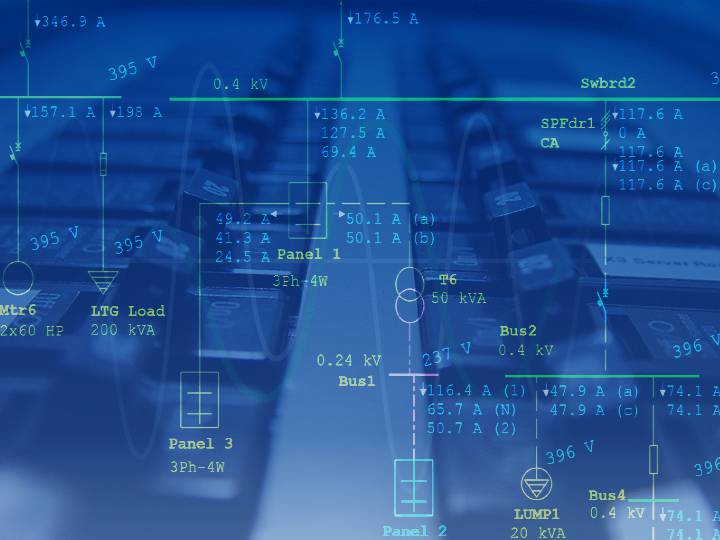
- Power Flow Simulation is a fundamental analysis module used for demand evaluation, power flow assessment, loss calculation, power factor correction, and voltage drop analysis.
- It studies the flow of power, current, voltage, real power, and reactive power in the system under various load conditions.
- Load flow studies are carried out to determine the voltage profile of the network under minimum and maximum grid voltage conditions, and to identify any overloading of equipment.
Device Duty Calculations are performed using ETAP Short Circuit Analysis software. This enables accurate determination of fault currents and automatic comparison with the manufacturer’s short circuit current ratings.
If any device is overstressed, alarms are displayed on the one-line diagram and are also included in the Short Circuit Analyzer and study reports.
The effect of both balanced and unbalanced faults can be analysed using ETAP Short Circuit software, including:
3-Phase faults
Single Phase faults
Line-to-Ground faults
Line-to-Line faults
Line-to-Line-to-Ground faults
ETAP Short Circuit software provides a comprehensive library of device short circuit current ratings, making it easy to select system elements and perform multiple types of short circuit analyses. The built-in analyzers, plots, and reports help in quickly identifying the worst-case fault current and corresponding device duty requirements.
- Transient Stability Analysis enables engineers to accurately simulate and analyse power system dynamics during system disturbances and other abnormal events. ETAP Transient Stability uses detailed and validated equipment models, protection functions, and built-in as well as user-defined graphical control models to perform studies for industrial, utility, and transmission power systems.
- Transient Stability refers to the ability of a power system to maintain synchronism when subjected to major disturbances such as faults, sudden line outages, or abrupt load addition or removal.
- Due to the nonlinear power–angle relationship, the system response involves significant changes in generator rotor angles. After such disturbances, rotor angle differences, rotor speeds, and power transfer vary rapidly. The magnitude of these changes depends on the severity and location of the disturbance.
- Transient Stability is a fast phenomenon and typically occurs within a few seconds, especially for generators located close to the disturbance point.
- The reliability of power system operation mainly depends on the overall performance of protection relays. Relays must operate for all faults within their own zone (primary protection) and also provide backup protection for faults in the immediately adjoining downstream zone, in case the primary relay in that zone fails to operate.
- The Overcurrent and Earth Fault Relay Coordination Study is carried out to determine the characteristics, ratings, and settings of overcurrent protective devices. The objective is to ensure that, during a fault or overload anywhere in the system, only the minimum necessary portion of the system is isolated without interrupting healthy loads.
- At the same time, the selected devices and settings must provide adequate protection against equipment overloads and interrupt short circuit currents as quickly as possible. Protection engineering therefore involves fault studies followed by relay setting calculations, checking, and coordination studies.
- These studies are essential to ensure that all protective relays operate correctly with proper discrimination, providing reliable, sensitive, and selective isolation of the faulty section of the power system network. Relay Coordination Studies are also conducted to review and verify existing relay settings.
- The main objective of the Relay Coordination Study is to determine optimum protection settings so that the faulty portion of the system is isolated at the earliest possible time, while maintaining reliable power supply to the healthy sections of the network.
- The objective of the Arc Flash Study is to determine the maximum incident energy levels at MV and LV switchgear.
- The study requires collection of necessary input data such as Single Line Diagrams (SLD), equipment parameters (voltage kV rating, power MVA rating, impedance), system fault level, X/R ratio, and protection relay settings.
- The Arc Flash Analysis program is a fully integrated module capable of evaluating multiple operating scenarios to determine the worst-case arc flash energy levels.
- The software also generates professional reports and high-quality arc flash hazard labels automatically.
- The Arc Flash Analysis module includes detailed single-phase and three-phase arc flash calculations, along with an advanced arc flash analyzer tool to summarise and present the results of the study effectively.
- The Harmonic Analysis module enables simulation of harmonic current and voltage sources, identification of harmonic-related issues, reduction of nuisance tripping, and design and testing of harmonic filters. It also helps in evaluating harmonic voltage and current distortion levels as per permissible limits.
- Comprehensive load flow and frequency scan calculations are performed using detailed harmonic source models and power system component frequency models.
- The results are presented graphically, including harmonic order details, harmonic spectrum plots, and waveform plots. The software also generates detailed reports for proper documentation and analysis.
- The Motor Acceleration Analysis module is used to perform motor starting and acceleration studies to optimise motor performance and ensure reliable operation of the electrical system.
- The study helps in accurately evaluating motor and load speed–torque characteristics during starting conditions.
- It also verifies whether transformers, power sources, motor feeders, and associated protective devices are properly sized to withstand starting current and transient conditions without affecting system stability.
- The Grid Islanding Study involves analysing the network configuration, load distribution, and protection systems to identify suitable sections of the network for islanding operation.
- Grid Islanding is the controlled separation of a portion of the power distribution network to form a self-sustaining “island” that can operate independently from the main grid.
- This study ensures that critical loads and essential facilities continue to receive uninterrupted power supply during grid outages or major disturbances.
- The primary objective of the Insulation Coordination Study is to coordinate the insulation levels of switchgear and other equipment with the protection system requirements.
- The study evaluates overvoltages arising from events such as cable energization, re-energization, fault application and clearing, and capacitor bank switching.
- Based on this analysis, the appropriate rating, sizing, and placement of surge arresters are determined to ensure adequate protection of the equipment.
- Electrical equipment reliability data should ideally be based on the historical performance of components operating in a similar environment to that of the proposed system. In cases where such specific data is not available, reliability survey data can be used as a reference for component performance.
- Reliability Analysis is a systematic approach used to evaluate the dependability and consistency of a system or process. It involves identifying possible failure modes, analysing their causes, and implementing appropriate measures to prevent or minimise their impact.